Update (2026-07-21): Normalized the public Rustzen product names and updated AICraft’s current role after its Skills catalog refactor.
When I started rustzen-admin, I was trying to answer a simple question: can Rust and React become a lightweight, clear, reusable starting point for small admin systems and internal tools?
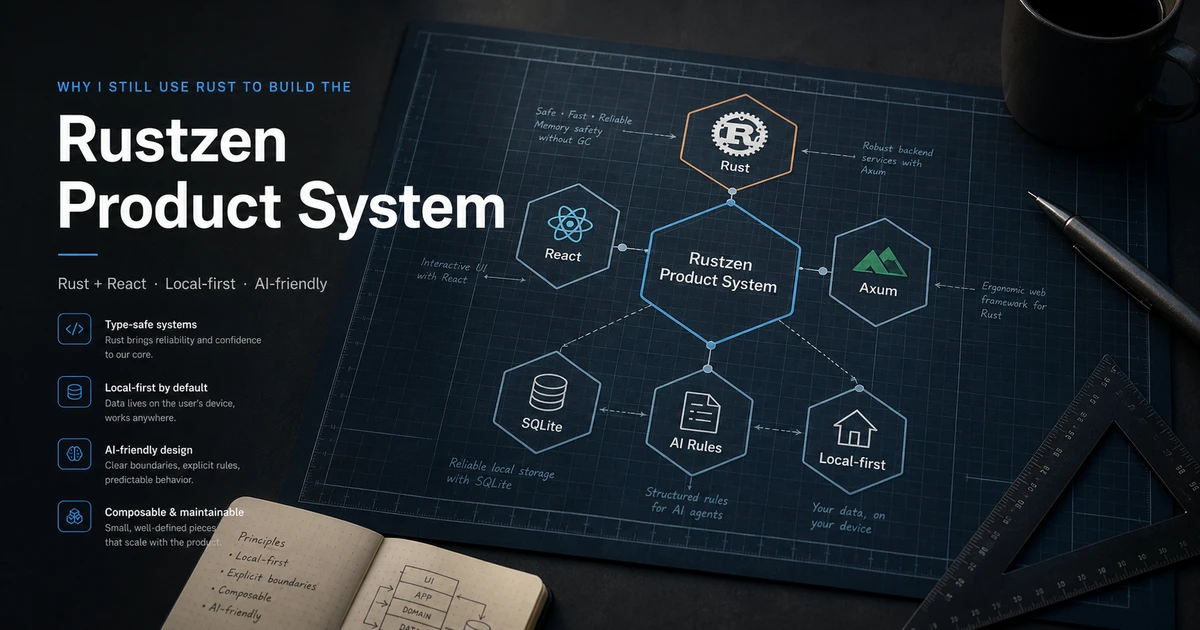
After building more of the Rustzen ecosystem, the value became clearer. The important part is not the admin UI itself. It is the engineering method behind it: explicit boundaries, simple deployment, local-first storage, AI-readable project rules, and long-term maintainability.
Project repo: rustzen/rustzen-admin
From Admin Template to Product Base
At first, I focused on login, permissions, menus, logs, APIs, frontend pages, and deployment scripts.
As the project grew, the real questions shifted:
- Are the repository boundaries clear?
- Is the frontend-backend contract stable?
- Can the system run locally first?
- Can deployment avoid unnecessary external dependencies?
- Can an AI assistant read the rules and keep changes scoped?
That became the direction of Rustzen: less premature complexity, more explainable and verifiable structure.
The Principles I Care About Now
Local-first by default
Many personal tools, desktop apps, internal dashboards, and lightweight admin systems do not need a heavy external service stack at the beginning.
I prefer to start with SQLite, a single service binary, explicit config, and a clear data directory. This makes running, moving, debugging, and restoring the system much easier.
AI-friendly is structural
AI-assisted development is only stable when the repository has deterministic structure: directory ownership, command entry points, migration rules, API response contracts, current documentation, and clear historical-document boundaries.
Those constraints reduce guessing, unrelated edits, and accidental refactors.
Do not add enterprise complexity too early
Rustzen is not trying to prove architectural sophistication. It is trying to make products maintainable, publishable, and reusable.
If one system is enough, I do not split it early. If SQLite is enough, I do not introduce heavier dependencies. If documentation can define the rule clearly, I do not build a framework before there is real pressure.
What rustzen-admin Means Now
rustzen-admin is now an engineering sample: Rust / Axum backend, React frontend, SQLite-first storage, monorepo layout, repository-level documentation, deployment assets, and collaboration rules.
It is not an isolated admin template. It is a reference point for products such as Zen Clear, Rustzen Zipper, and Rustzen Clipboard.
Result
Rustzen is no longer a single repository. It is becoming a product system around developer productivity, local-first tools, and AI-assisted engineering:
rustzen-admin: admin and console engineering reference- Zen Clear: macOS disk analysis and cleanup for developers
- Rustzen Zipper: release packaging and zip archive tooling
- Rustzen Clipboard: local-first clipboard tool exploration
aicraft: installable AI Skills, routing standards, and validation infrastructurefeeds-hub: AI-powered feed automation exampleblog: long-form writing, experience notes, and public project memory
I first chose Rust because it can ship as a stable, lightweight binary. I continue using Rust because it forces clearer thinking about boundaries, data, risk, and reuse.
It did not make development easier. It made the system more explainable.